


You spend hours on a video, hit publish, and… the click-through rate crawls at 2–3%. Meanwhile, other channels pull views with titles that look borderline ridiculous, and you start googling YouTube clickbait examples to figure out where the line is between smart marketing and straight-up lying.
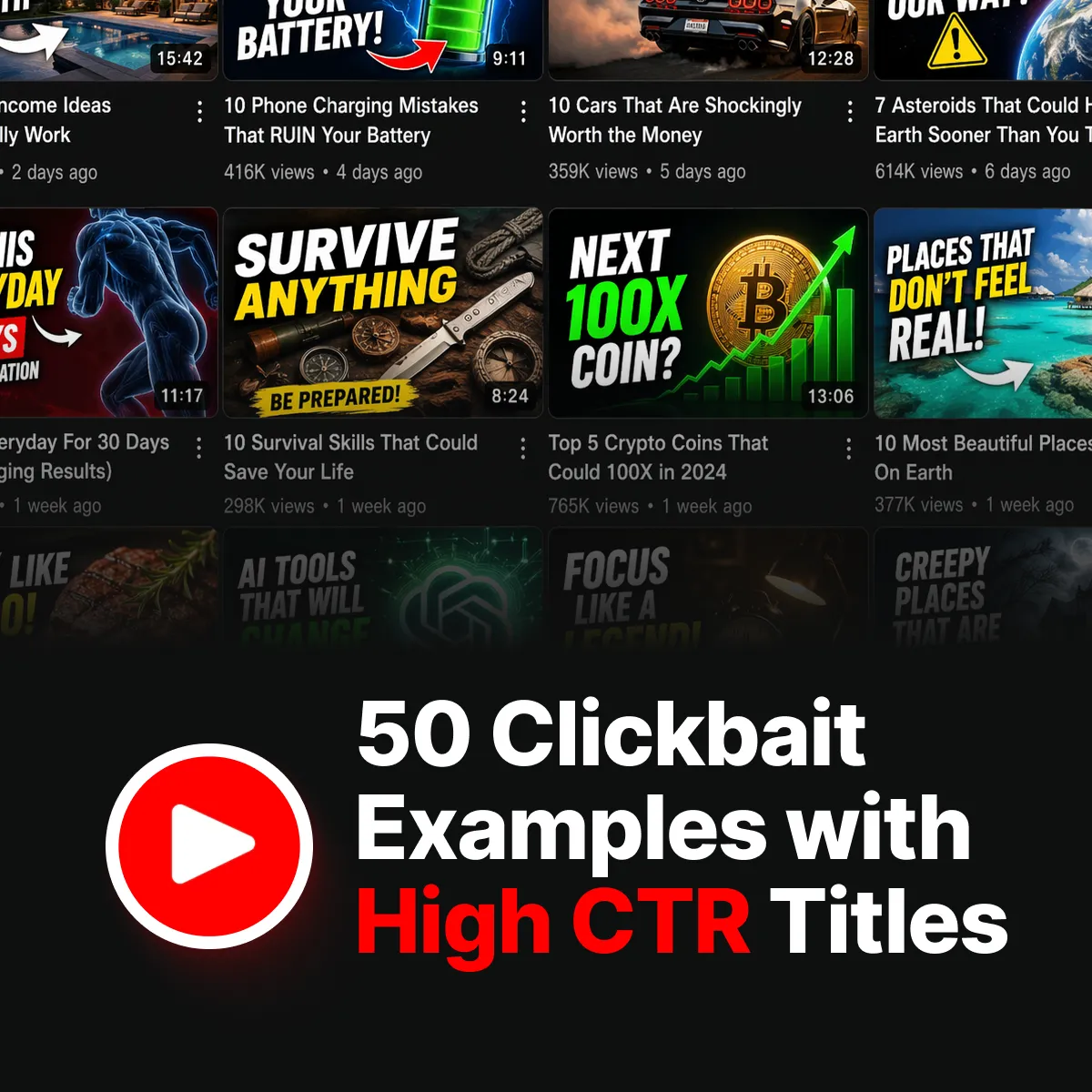
This guide shows you how to live on that line—without crossing it. We’ll cover what “good” clickbait looks like in 2026, a simple framework for ethical hooks, and 50 title and thumbnail ideas you can swipe, tweak, and test on your own channel. If you also want to see how clickbait plays out across longer content like blog posts and newsletters, check our broader clickbait headline examples breakdown.
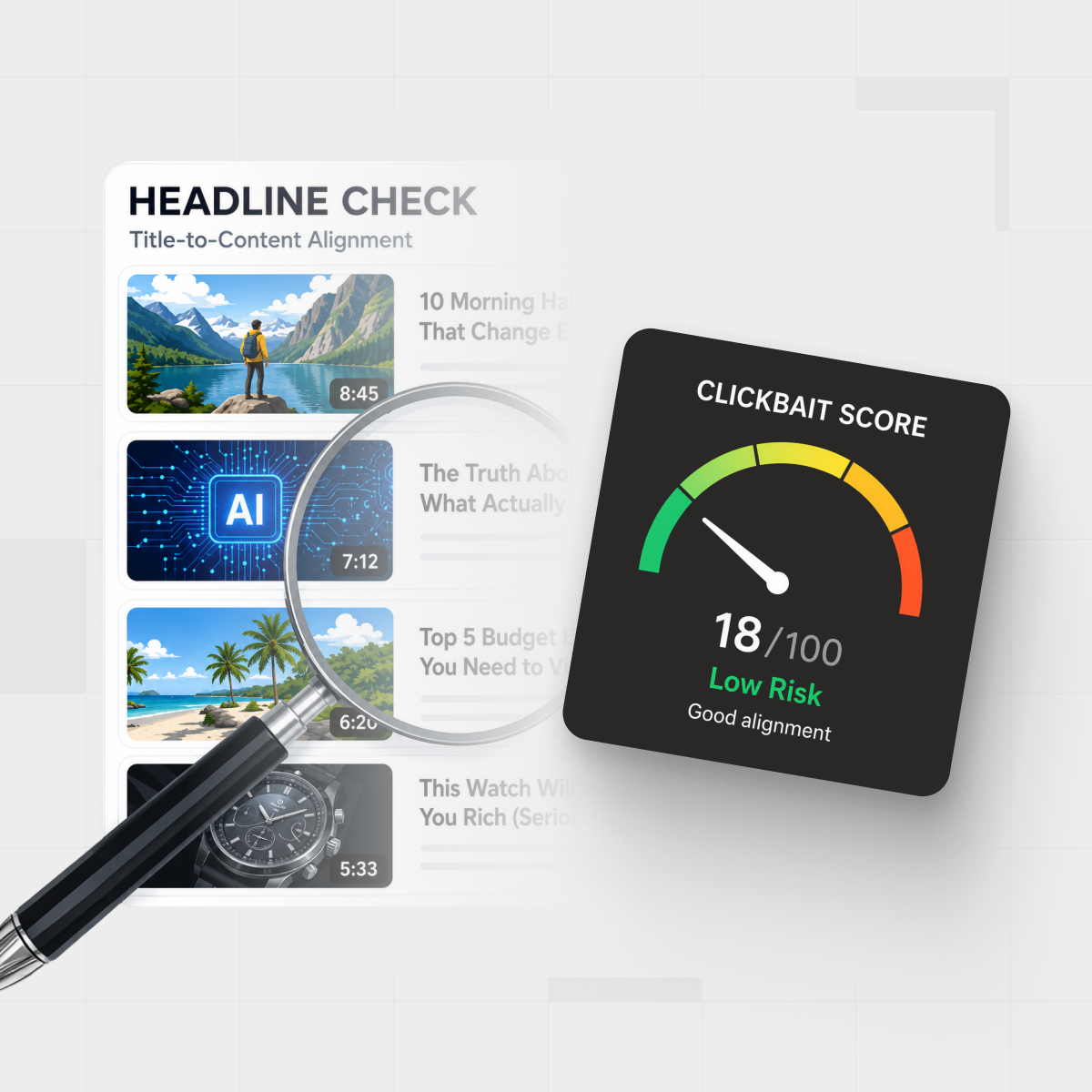
We’ll also show you how to sanity-check your ideas with IsThisClickbait, so your titles stay persuasive without betraying your viewers’ trust.
TL;DR: honest clickbait that actually works
Short version:
- Clickbait itself isn’t the enemy; misleading clickbait is. Good titles exaggerate the tension, not the outcome.
- High-CTR titles usually mix curiosity + tension + clear topic + a specific viewer in mind.
- Thumbnails do the emotional work; titles do the clarity work.
- Tools like IsThisClickbait help you spot when your hook overpromises compared with your actual video.
Good titles exaggerate the tension, not the outcome.
What “clickbait” means on YouTube now
In this guide, “clickbait” means any title or thumbnail that uses strong emotion or curiosity to earn a click without lying about what happens in the video. Viewers (and YouTube) mainly get upset when the packaging promises one thing, and the video delivers something else.
Because YouTube weighs impressions, click-through rate (CTR), and watch time together, misleading hooks might spike clicks but quickly stop getting recommended - YouTube’s own CTR FAQs warn against clickbait that drives clicks but not retention.
The 4 rules of honest YouTube clickbait
1. Exaggerate the stakes, not the facts
Saying “This mistake is silently killing your channel” is fair if you genuinely walk through a mistake that hurts performance. Saying “I FOUND THE SECRET YOUTUBE EXPLOIT” and then sharing generic tips? That’s how you lose trust.
2. Make one bold promise, not five mild ones
Skip laundry-list titles like “How to grow on YouTube (titles, thumbnails, hooks, retention tips)”. A sharper version: “Why your YouTube thumbnails are killing your views (and how to fix them)”.
3. Let the thumbnail carry most of the drama
YouTube’s Creator resources and Help articles on custom thumbnails repeat the same pattern: faces, contrast, and one clear emotion beat walls of text. Use:
- Big, legible text (3–5 words)
- Obvious expressions: shock, delight, regret, suspense
- Simple props or screenshots that match the story
4. Match the hook to your actual content
If your video is a calm tutorial, a screaming emergency-style thumbnail will feel off. Great channels stick to a consistent “promise style” that matches how the host talks and teaches. This is where IsThisClickbait helps: it reads your transcript, compares it to your title and thumbnail, and scores how honest your hook really is before you spend ad money or push the link to your list.
50 YouTube clickbait examples (titles + thumbnail ideas)
Use these as patterns, not scripts. Swap in your niche, numbers, and outcomes, then test. If you have our browser extension installed alongside YouTube, you can also run your final combination through an IsThisClickbait analysis to see how it scores.
How to use these examples
- Pick 3–5 that fit your topic and audience.
- Customize the bold claim to match what actually happens in your video.
- Sketch the thumbnail first, then adjust the title so they work together.

1–10: Curiosity-gap hooks
Tease a missing detail or surprising outcome; let a simple, bold thumbnail hint at the reveal without fully spoiling it.
- “I did ___ wrong for 5 years (you probably do too)”
- “Everyone teaches ___ like this. Here’s what they skip.”
- “This tiny change doubled my views overnight”
- “The setting secretly limiting your views”
- “The number no one explains in YouTube Studio”
- “What happens if you upload daily for 30 days?”
- “This ‘harmless’ habit is killing your retention”
- “I copied my favorite creator for a week. Here’s what I learned.”
- “The video I almost didn’t upload (now my biggest one)”
- “You’re optimizing the wrong thing on YouTube”
11–20: “I tried X” story hooks
Turn challenges into stories—show what you tried, for how long, and hint at the result.
- “I tried MrBeast-style thumbnails on a small channel”
- “I followed YouTube’s official advice for 90 days”
- “I paid 3 editors to fix the same video”
- “I let AI write my titles for a month”
- “I tried 10 thumbnails for 1 video (here’s the winner)”
- “I stopped caring about the algorithm. This happened.”
- “I posted 0 videos for 60 days. Did my channel die?”
- “I copied TikTok for my titles. Huge mistake?”
- “I let my subscribers pick my titles”
- “I said yes to every video idea for a month”
21–30: Numbers & frameworks
Use numbers and comparisons so viewers instantly see the structure and payoff of your advice.
- “7 title formulas that pulled 10M+ views (with examples)”
- “3 thumbnails that ruined my videos (and how I fixed them)”
- “5 hooks viewers can’t resist on YouTube right now”
- “The 4-step system behind every viral title I’ve written”
- “Title vs. thumbnail: which matters more? (tested)”
- “We A/B tested 100 thumbnails. Here’s what actually matters.”
- “The 80/20 of YouTube CTR (what moves the needle)”
- “The only 9 words your thumbnail text ever needs”
- “5 deadly thumbnail clichés (and what to use instead)”
- “25 clickworthy words for your next title”
31–40: Before/after & transformation
Highlight clear before/after shifts in views, CTR, branding, or results so viewers can picture the transformation.
- “From 1,247 to 104,392 views in 30 days (same channel)”
- “I rewrote this terrible title. Guess which won.”
- “We fixed 3 things on this channel. Here’s the result.”
- “This dead video came back to life”
- “From 2% to 9% CTR: what changed?”
- “The thumbnail glow-up your channel needs”
- “Fixing subscribers’ worst titles (live roast)”
- “We redesigned our oldest videos. Did YouTube care?”
- “Turning this boring topic into a viral video”
- “I rebuilt my channel brand from scratch”
41–50: Polarizing & contrarian (without being a jerk)
Take a strong stance against common advice, then back it up with a practical alternative in the video.
- “Stop listening to random YouTube ‘growth hacks’”
- “Views don’t matter as much as this”
- “Why copying viral channels keeps you small”
- “Your niche isn’t too crowded. Here’s the real problem.”
- “The algorithm isn’t your enemy (you are)”
- “Stop starting channels. Do this first instead.”
- “You don’t need better gear. You need this.”
- “Subscriber count is the most overrated metric”
- “Stop blaming your thumbnails for bad videos”
- “Clickbait isn’t the problem. Boring videos are.”
Clickbait isn’t the problem. Boring videos are.
If you want more swipable hooks later, bookmark this article and check out our post on YouTube title formulas that convert and our broader clickbait examples guide.
How to test your own titles and thumbnails fast
Treat hooks like drafts, not guesses. A simple workflow is enough to turn every new video into a small experiment.
- Brainstorm 5–10 hook variations. Remix patterns from the list above with your own voice.
- Score them with a clickbait analyzer. With the IsThisClickbait extension, paste your draft title, add your thumbnail, and tweak anything that overpromises.
- Publish the strongest honest hook. Pick the option that’s clear, specific, and high-tension—not just the most dramatic.
- Review CTR and retention at 48–72 hours and again at 28 days. Healthy CTR with fast drop-offs usually means your hook is overselling; solid CTR plus steady retention means you’ve nailed the promise.

If you want help skimming long videos while you research ideas, our YouTube summary extensions comparison shows which tools make it easiest to turn hour-long clips into quick briefs.
FAQs about YouTube clickbait (for creators who care about trust)
Is all clickbait bad?
Not automatically. Viewers usually complain about “clickbait” when the title or thumbnail sets an expectation the video doesn’t meet. If your hook is emotionally strong but accurately summarizes what happens, you’re using honest packaging, not scams.
What’s a “good” CTR on YouTube?
There isn’t one magic CTR number—it varies by niche, audience size, and traffic source. Many educational and how-to channels sit in the mid single digits, while tightly targeted or search-driven videos can go higher. Focus on raising your own baseline over time instead of chasing someone else’s screenshot.
CTR benchmarks at a glance (2026)
- YouTube’s CTR FAQs say about half of channels sit between 2–10% impressions CTR.
- Thumbmagic’s YouTube CTR benchmarks call around 4–6% solid for most channels, with gaming closer to 8.5% and education around 4.5%.
How do I know if my YouTube title goes too far?
Check three things: the moment in your thumbnail actually happens, the main promise in your title is delivered, and you’d be comfortable defending the hook to a friend. If any of those feel shaky, tone it down or run it through IsThisClickbait to see where expectations and content don’t line up.
Can I reuse the same clickbait patterns across my channel?
Yes. Most successful channels rely on a small set of repeatable hook frameworks and just swap in new topics. Reuse them until you see CTR and watch-time slipping, then rotate in fresh angles so long-time viewers don’t get numb to the pattern.
Next steps: turn these examples into real views
- Pick 3–5 patterns from the list and rewrite them for your next upload.
- Sketch 2 thumbnail ideas per title and pick the one that tells the clearest story at a glance.
- Install the IsThisClickbait browser extension so every new video gets an honest clickbait score, summary, and key moments alongside YouTube.
- Review your top 10 existing videos and ask: “Would I click this today?” If not, queue up some thumbnail and title refreshes.
Your viewers’ time is precious. Hooks that respect that time tend to win more than once—they bring people back.