


You’re staring at a blank page. Your report is finished, your data looks solid, and now your professor, manager, or client wants “a short overview” on top. Should that be an abstract or an executive summary?
The phrase executive summary vs abstract shows up everywhere from journal guidelines to corporate templates, but the explanations often sound more academic than helpful. This guide clears that up in plain English so you know which one to use, how long it should be, and what to put inside.

A modern team reviewing reports and deciding how to present the findings as an executive summary vs abstract.
TL;DR: key differences in one glance
- Audience: Abstract → experts and reviewers. Executive summary → decision‑makers and busy leaders.
- Goal: Abstract → describe what you did. Executive summary → help someone decide what to do next.
- Length: Abstract → ~150–250 words. Executive summary → 1–4 pages, or 5–10% of the full report.
- Extras: Abstracts rarely tell people what to decide; executive summaries usually include clear recommendations.
What is an abstract?
An abstract is a short, factual summary of a research paper, thesis, or technical report. It tells readers, in about 150–250 words, what question you tackled, how you tackled it, and what you found.
Abstracts live in academic journals, conference programs, databases like arXiv, and digital libraries. They help researchers scan dozens of papers in minutes and decide which ones are worth reading in full. Good writing centers like Purdue OWL treat them as miniature versions of the whole paper.
When you’ll write an abstract
- Submitting a paper to a journal or conference
- Uploading a preprint to a repository
- Sharing a thesis or dissertation through your university library
- Preparing a research poster or talk for a scientific meeting
Typical abstract structure
Most abstracts quietly follow the same pattern:
- Background: One sentence of context and the problem.
- Objective: What you set out to test or explore.
- Methods: How you did it (at a high level).
- Results: The main findings in plain language.
- Conclusion: What those findings mean or why they matter.
Notice what’s missing: there’s usually no sales pitch, no “for the CEO” explanation, and no long list of action items. That’s where executive summaries come in.
What is an executive summary?
An executive summary is a short, decision‑focused version of a longer business or policy document. It gives senior leaders, clients, or sponsors the headlines: what’s going on, why it matters, and what you recommend.
You’ll see executive summaries on top of strategy decks, market research reports, internal investigations, evaluation studies, and government policy papers. They read less like a lab note and more like a briefing for someone with no spare time.
Where executive summaries show up
- Consulting reports and board papers
- Funding proposals and grant applications
- Policy briefs for public agencies
- Internal business cases and product reviews
Typical executive summary structure
- Context: What problem or opportunity triggered this work?
- Key findings: Three to five high‑impact insights.
- Implications: Why these findings matter for the organization.
- Recommendations: What you think decision‑makers should do next.
- Next steps: Timelines, owners, or options.
Think of an abstract as the movie trailer and an executive summary as the pitch you send to the studio boss.
If your “report” is actually a YouTube webinar or a long lecture, tools like IsThisClickbait can help you get from transcript to executive summary‑ready notes without scrubbing through the whole video.
Executive summary vs abstract: 7 key differences
Here’s the side‑by‑side comparison most people wish they had the first time they wrote either one.

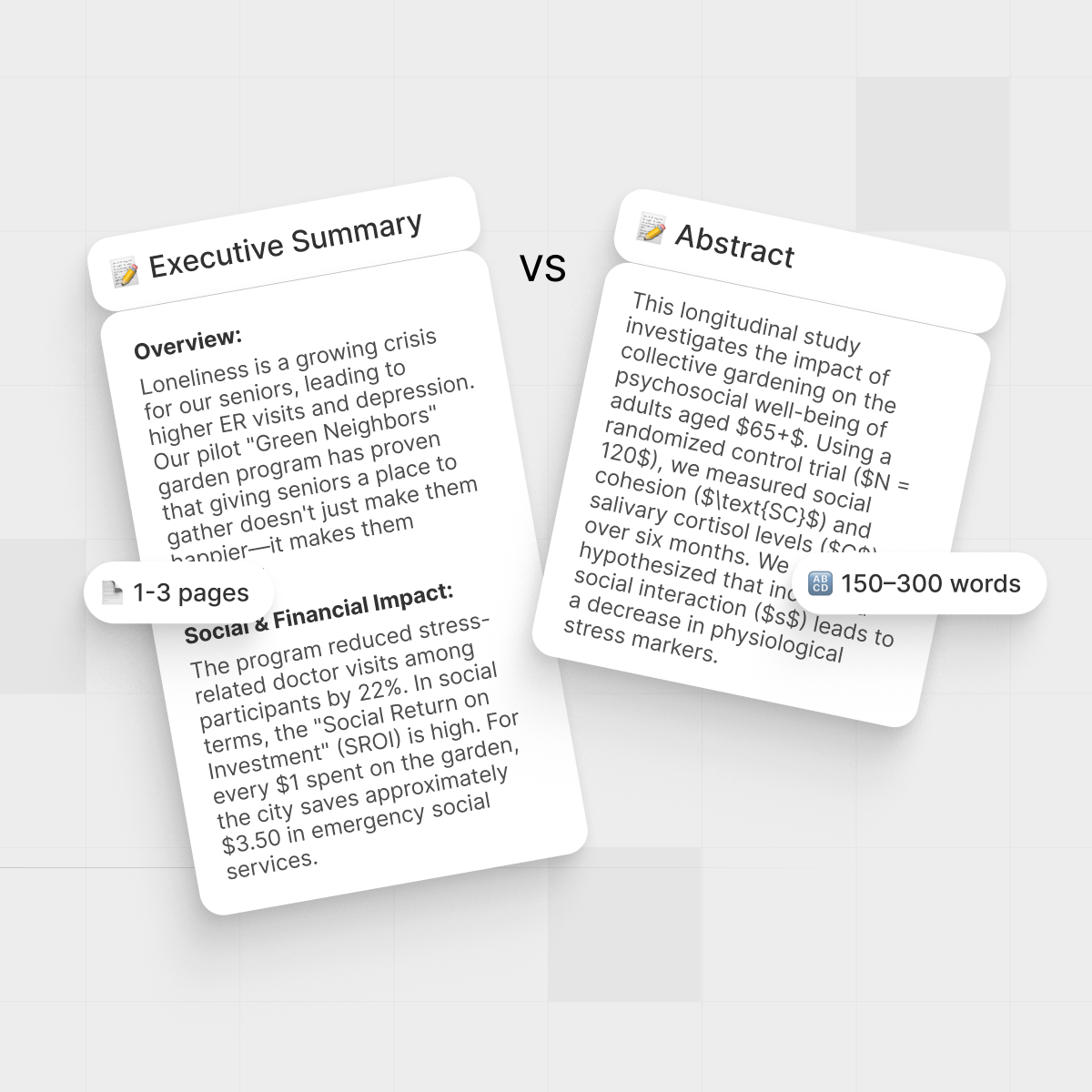
Visualizing the executive summary vs abstract side by side as two different but related documents.
If you’re writing for a journal, “abstract” is almost always the right term. If you’re writing for a board pack, a sponsor, or a leadership team, you’re in executive summary territory.
Formats and length in 2026
Because so much work now happens in shared docs, Notion pages, and long videos, the old “one‑page Word file” picture is only part of the story.

Turning long video transcripts into structured summaries that can become an abstract or an executive summary.
Abstract formats in 2026
- Structured abstracts: Headings like Background, Methods, Results, Conclusion, often required by medical and engineering journals.
- Unstructured abstracts: One compact paragraph without headings, still common in many fields.
- Graphical abstracts: A visual diagram plus a short text abstract, especially in chemistry and life sciences.
Even with AI tools, most supervisors and editors still expect you to stick to the journal’s word limit and structure. Many students now feed a paper draft or YouTube lecture transcript into an AI YouTube summary tool, then tighten the output by hand so it matches those rules.
Executive summary formats in 2026
- Classic memo style: 1–2 pages of prose at the front of a PDF or doc.
- Slide‑based: 3–5 slides at the start of a deck with problem, insight, and recommendation sections.
- Hybrid: A short written summary plus a bullet “one‑pager” and a link to a 3–5 minute video briefing.
Because many leaders skim on phones, teams often pair the written executive summary with a quick bullet list or summary table at the top. Some groups also link to timestamped YouTube clips, generated with tools like IsThisClickbait, so a VP can jump straight to a key moment in a recorded briefing.
Real examples you can copy and adapt
Let’s look at short, realistic examples for the same project: reducing churn in a subscription app. First, an abstract; then, an executive summary for the same work.
Sample abstract (research paper)
Title: Predicting and Reducing Subscriber Churn in a Mobile Learning App
Abstract: Subscriber churn limits the growth and sustainability of mobile learning platforms. This study examined behavioral and content‑consumption signals associated with voluntary churn in a cohort of 42,381 users of a subscription‑based learning app. We trained gradient‑boosted trees on log‑level data, including session frequency, lesson completion, video watch time, and support interactions, to predict churn within a 30‑day horizon. The resulting model achieved an AUC of 0.84 on a held‑out test set. We then ran a four‑week experiment that targeted high‑risk users with personalized in‑app nudges and content recommendations. Treated users showed a 9.7% relative reduction in churn versus controls. These findings suggest that combining behavioral prediction with lightweight retention interventions can materially improve subscriber outcomes.
Sample executive summary (business report)
Project: Reducing Subscriber Churn in the LearnFast App
Overview. LearnFast’s monthly subscriber churn has risen from 4.1% to 5.3% over the past year, putting both revenue and marketing efficiency under pressure. Our team analyzed user behavior across 42,000+ subscribers and tested targeted retention tactics to understand what drives churn and how to counter it.
Key findings.
- Churn risk spikes after two weeks of no meaningful activity (no lessons completed, minimal video watch time).
- Subscribers who reach three completed courses in their first 60 days churn at roughly half the rate of others.
- High‑touch support (chat or email) within the first month is linked to stronger retention for new users with setup issues.
What we tested. Using a predictive model, we flagged high‑risk users and sent them a mix of personalized course suggestions, “get back on track” reminders, and targeted support outreach over four weeks.
Impact. Users who received these interventions showed a 9–10% relative reduction in churn versus a control group, with an estimated net revenue lift of $320k/year at current scale.
Recommendations.
- Productize the churn‑prediction model and interventions as an automated lifecycle program.
- Set a target of three completed courses in the first 60 days and design onboarding around that milestone.
- Train support agents on a short “win‑back” playbook for at‑risk subscribers.
Same project, two different write‑ups. The abstract helps other researchers judge whether to read the full study. The executive summary helps leaders decide whether to invest in rolling out the churn‑reduction program.
If your “data” lives inside long YouTube walkthroughs or stakeholder interviews, you can use a transcript plus a YouTube summary workflow to draft either version, then refine the language by hand.
How to choose: abstract or executive summary?
When you’re under deadline, a quick rule of thumb helps. Ask yourself these questions:
1. Who is the main reader?
- Expert reviewers, supervisors, journal editors? Write an abstract.
- Executives, clients, non‑technical sponsors? Write an executive summary.
2. What decision should this text support?
- If the goal is “Should we accept, fund, or cite this research?”, an abstract is the right format.
- If the goal is “Should we approve, invest, change course, or ship this?”, an executive summary fits better.
3. How much space do you have?
- Calls for papers and conference guidelines usually prescribe a word limit for the abstract. Stick to it.
- Business and policy audiences often expect 1–2 pages. Longer than four pages and people start skipping.
Still unsure? Check the template or instructions you were given. Universities and writing centers like the UNC Writing Center share helpful examples, and your organization may have its own standard.
Where AI and YouTube summaries fit in
In 2026, most knowledge workers and students have at least one AI tool in their stack. That can be a real help for both abstracts and executive summaries—as long as you stay in control.

Refining an executive summary vs abstract with AI tools, then editing together to keep it accurate and reader‑friendly.
Turning videos into draft abstracts or summaries
If your “source document” is a one‑hour YouTube lecture, a town‑hall recording, or a dense webinar, it’s tough to rewatch everything just to write a half‑page overview. That’s exactly where IsThisClickbait shines: it turns the video transcript into a structured summary, key points, and timestamped highlights you can paste into your notes.
From there, you can:
- Trim the summary down to 150–250 words and adjust the tone for an abstract.
- Reorder key points around “problem → insight → recommendation” for an executive summary.
- Use timestamps to link out to “must‑watch” moments inside your written summary.
Staying honest and reader‑friendly
One of the biggest risks with AI‑generated text is that it can sound confident while missing key limits or uncertainties. That’s why we built our own clickbait and explanation: to help people spot when titles and thumbnails oversell the real content.
Use the same mindset in your writing:
- Keep your claims as strong as your evidence, especially in abstracts.
- Make recommendations in executive summaries, but be clear about risks and trade‑offs.
- Read AI‑drafted text out loud and edit until it sounds like something you’d say to a smart colleague.
If you want to stress‑test your own title and summary for a video‑based report, you can always run it through IsThisClickbait and see whether the transcript backs up the promise.
Summary takeaways
- Abstracts serve researchers and reviewers; they condense methods and results into one tight paragraph.
- Executive summaries serve leaders and sponsors; they frame the situation, highlight insights, and spell out next steps.
- The same project can have both: an abstract for the academic record and an executive summary for the people paying the bill.
- In 2026, AI tools and YouTube transcript analyzers make the first draft faster, but human judgment still shapes what’s accurate, fair, and useful.
Next step: Got a long lecture, webinar, or product teardown that needs a summary on top? Start analyzing a video with IsThisClickbait and turn it into an abstract, an executive summary, or both.