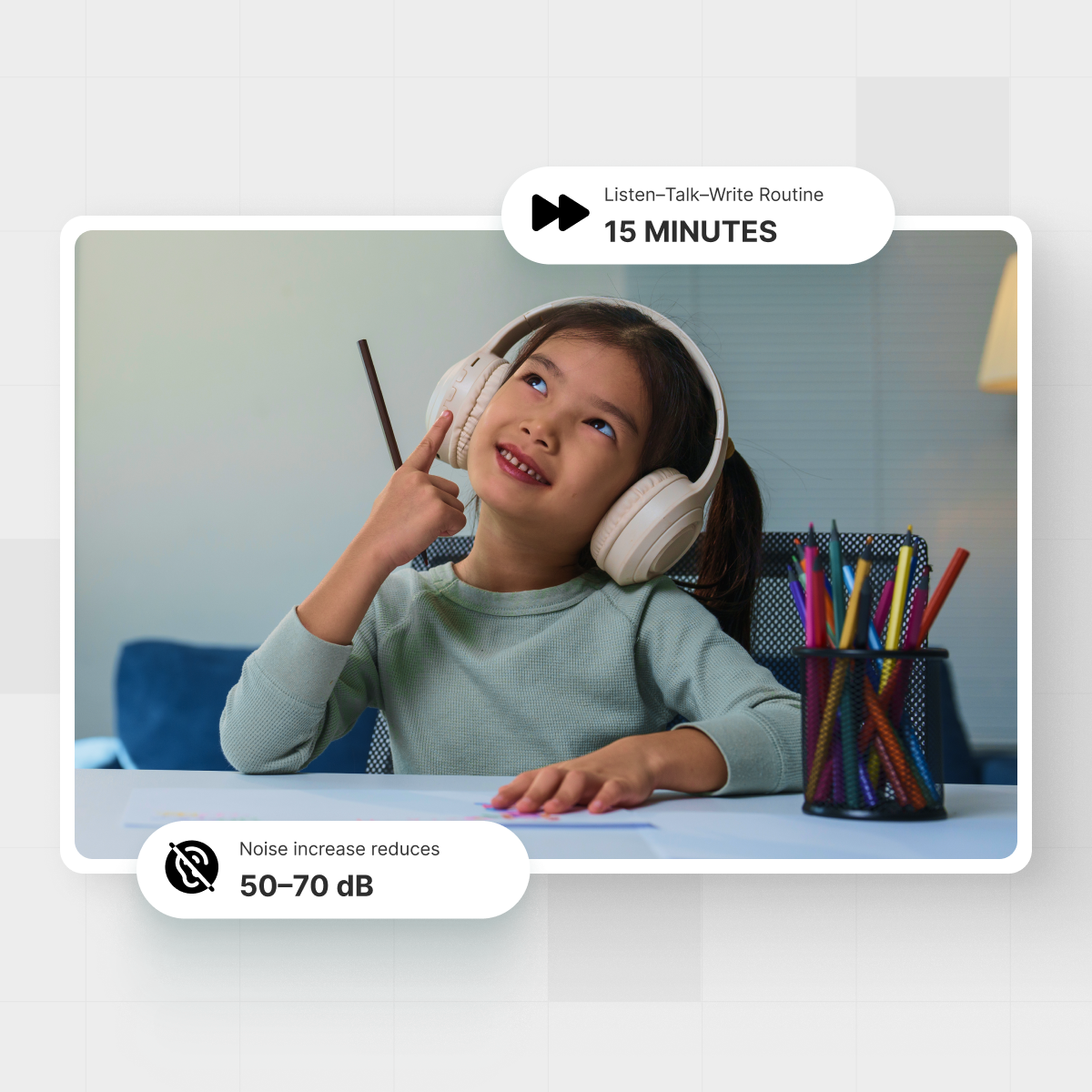



Every teacher knows the student who lights up the minute class starts talking. For that child, auditory learning strategies are not just “nice to have”; they’re the doorway into the lesson. When instruction leans only on slides, packets, and silent reading, those students can look checked out even when their brains are wide awake.
The good news: you do not need to redesign your entire curriculum. With a few small shifts in how you use discussion, storytelling, and sound, you can turn everyday lessons into lessons that feel made for students who learn best by hearing and speaking.

A sound-rich classroom discussion can turn everyday lessons into experiences that feel designed for auditory learners.
TL;DR: How to Support Auditory Learners
- Think “talk, tell, and listen” in every lesson: short explanations, structured discussion, and chances to speak ideas aloud.
- Use the Listen–Talk–Write 15-Minute Routine a few times each week to give every lesson a quick auditory pass, from hook to verbal rehearsal.
- Use short storytelling in every subject to give concepts a memorable hook.
- Bring in sound intentionally: audio directions, quick cues, and short clips instead of constant background noise.
- Let students process verbally before writing: pair-shares, oral rehearsal, and recorded thinking.
- Use YouTube transcripts or summaries to jump straight to the most helpful parts of a video.
What Is an Auditory Learner?
An auditory learner is a student who tends to understand and remember information best when it is heard or spoken. These learners tune in when you tell a story, model a think-aloud, or host a whole-class discussion. They often excel in class debates and can repeat details from a lesson that others have long forgotten.
At the same time, research around learning styles is mixed. A major review in Psychological Science in the Public Interest found little evidence that matching teaching to students’ self-reported “learning styles” improves outcomes, even though students do have preferences. That review and later summaries suggest that tightly labeling students (auditory, visual, kinesthetic) does not match how the brain actually works.
A more helpful lens is Universal Design for Learning (UDL): offer multiple ways to represent content, let students act and express in different modes, and build in engagement for a wide range of brains.
In other words, you do not have to track who is “officially” an auditory learner. Instead, build lessons that consistently use sound and talk in smart ways—and then watch which students come alive.
Why Sound-Rich Teaching Helps Many Learners
Think about the last staff meeting where someone read slides word-for-word versus one where a colleague told a story that made everyone laugh. Which session stayed with you longer? Students have the same experience: the human voice carries tone, rhythm, emphasis, and emotion that text alone rarely matches.
Sound-rich instruction pairs well with strategies backed by cognitive science:
- Retrieval practice: Students say answers out loud, quiz each other, or explain steps verbally.
- Elaboration: Learners connect new ideas to prior knowledge by talking through examples.
- Dual coding: Combining spoken words with visuals (charts, diagrams, timelines) builds stronger memory traces.
Large reviews of learning techniques show that strategies like practice testing and distributed practice clearly outperform simple rereading. For auditory learners, building those retrieval and explanation moments into class talk gives them a powerful, research-backed way to lock in content.
When you design for the auditory learner style, you often help multilingual students, students with ADHD, and anyone who processes best through conversation—this is the heart of inclusive, multimodal instruction.
Core Auditory Learning Strategies You Can Use This Week
Here are high-yield moves you can plug into almost any K-12 classroom without rebuilding your unit plans.

Think–pair–share routines give auditory learners a low-stakes chance to talk through ideas before sharing with the whole class.
1. Think–Pair–Share with a Twist
- Ask a question, give 20–30 seconds of quiet think time.
- Students share answers with a partner, then optionally with a small group.
- Call on a handful of pairs to report back, but let them quote each other: “My partner said…”
That last step helps auditory learners: they listen more closely when they know a peer’s words might be shared with the whole class.
2. Short Teacher Think-Alouds
Model how you read a paragraph, solve a word problem, or plan a lab by speaking your thoughts in real time. Keep it under two minutes and pair it with a quick student try-it so they can copy the inner voice they just heard.
3. Verbal Rehearsal Before Writing
Auditory learners often freeze when asked to write a paragraph. Let them:
- Record a 30-second voice memo stating their main idea.
- Explain their plan to a partner using sentence frames.
- Tell you their opening sentence before they put it on paper.
Once they hear their own words, the written version flows more smoothly.
Using Discussions to Support the Auditory Learner Style
Whole-class discussions can turn into “three kids talk, everyone else zones out.” To make them work for auditory learners without losing the rest of the room, borrow simple protocols.
Use Clear Roles and Structures
- Circle discussions: Students sit where they can see faces, not just the back of heads.
- Talking sticks or cards: Everyone gets two contributions per round, then listens.
- Sentence stems: Post starters such as “I hear you saying…”, “Can you clarify…?”, “I’d like to add…”
Record or Summarize Key Points
For classes that watch a lot of lectures or YouTube explainers, connect live talk with recorded media. After a discussion, quickly jot three big takeaways on the board or in a shared doc, or use a video-summary tool to pull key points from longer clips so students can focus on listening and responding in real time. For more structures, Edutopia maintains practical guides on leading effective classroom discussions that pair well with auditory-focused lessons.
Teaching Through Storytelling Across Subjects
Storytelling is the secret favorite of many auditory learners. A narrative gives them a mental soundtrack to replay later: characters, conflict, turning points, and resolution.
- ELA: Turn grammar into mini-stories about sentences “misbehaving” until a punctuation hero steps in.
- Math: Wrap word problems in stories about real students, sports stats, or school events.
- Science: Tell the “biography” of an atom, a cell, or a planet through the challenges it faces.
- Social studies: Use first-person narratives, diary entries, or podcast-style monologues from historical figures.
Invite students to create short oral stories themselves—individually or in groups—and then turn those stories into written pieces, diagrams, or skits.
If you already lean on video in your class, try a similar pattern: listen to a short story or clip, retell it in pairs, then turn that retell into notes, diagrams, or quick written pieces. You get cross-modal learning without extra grading on your plate.
Using Sound, Music, and Audio Clips (Without Chaos)
Many teachers hesitate to add more sound because they picture a room buzzing out of control. The key is thoughtful, brief audio, not constant noise.
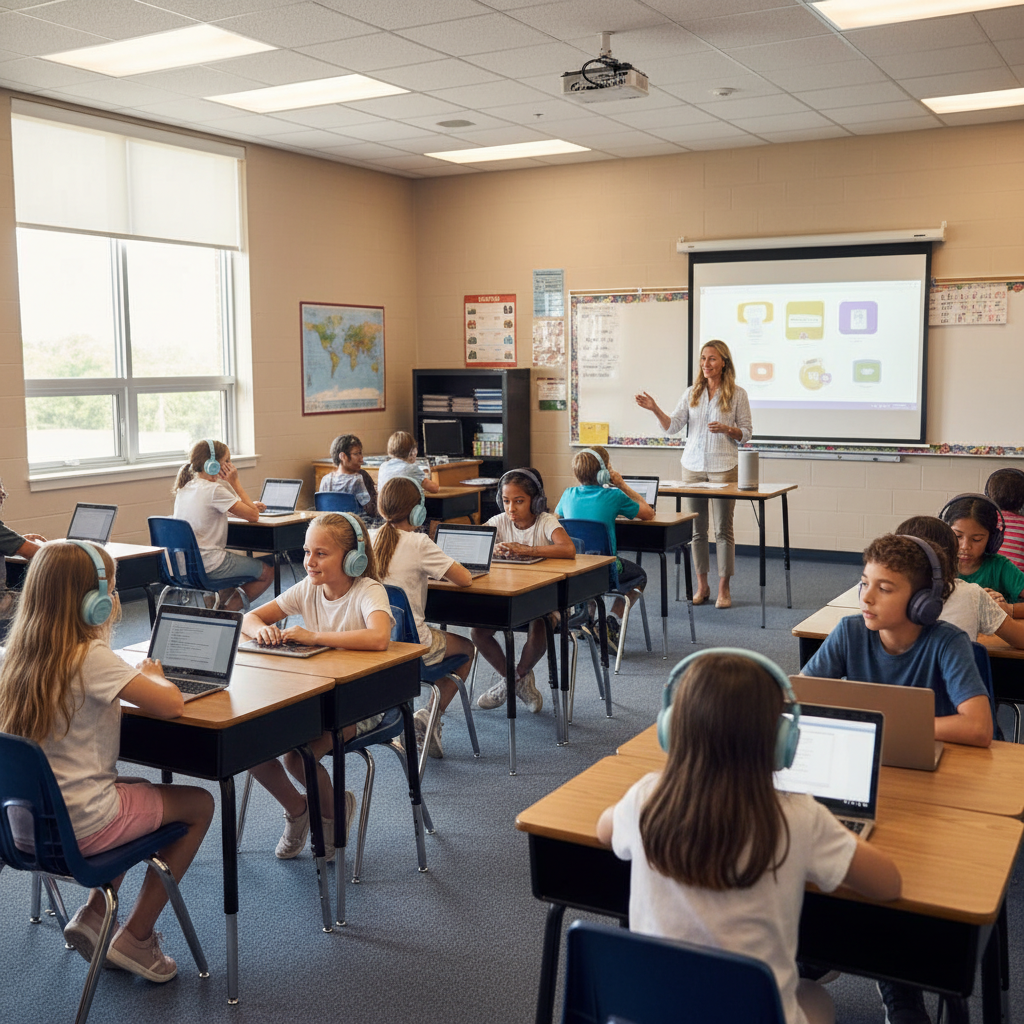
Purposeful sound—short clips, clear cues, or headphones for targeted listening—supports auditory learners without adding chaos.
- Micro audio clips: 10–60 second clips of speeches, interviews, or sounds (rainforest, heartbeats, machinery) as a hook.
- Consistent sound cues: One chime that signals “eyes up,” another for “turn and talk.” Younger students in particular rely on these.
- Instrumental background: Soft, lyric-free tracks during independent work can help some auditory learners stay grounded.
- Headphones: For students with IEPs, video-based instructions through headphones can cut down on distractions.
Recent research backs up what you feel on a loud day: a 2025 meta-analysis of 21 studies with children and adolescents found that noise has a moderate negative effect on academic and cognitive performance, especially for younger students. Another large classroom study of nearly 1,000 secondary students found that raising classroom noise from about 50 to 70 decibels significantly reduced reading comprehension and vocabulary performance, so keeping extra noise low makes it easier for purposeful sound—your voice, a short audio clip, a partner conversation—to do its job.
"Noise is random; purposeful sound is brief, focused, and tied to what students are learning."
When you pull clips from YouTube, skim the transcript or timestamps ahead of time so you can grab a short, targeted segment instead of guessing where the explanation begins.
For further reading on classroom noise and learning, the American Psychological Association has accessible overviews on environmental factors and attention in students.
Helping Auditory Learners During Independent Work & Assessment
Independent work is often where auditory learners quietly sink. Everyone else starts writing, while they are still trying to replay directions in their head.
- Audio directions: Record brief instructions once and post the file or attach it in your LMS so students can replay as needed.
- Check-for-understanding questions: Before students start, ask two or three volunteers to restate the task in their own words.
- Whisper rehearsal: Let students quietly whisper an answer or paragraph before writing, especially in early grades.
- Oral scaffolds for assessments: When accommodations allow it, read test items aloud, or offer a small-group setting where students can hear questions again.
If you use recorded lectures or flipped lessons, a good video-summary tool—or even auto-generated transcripts—can give auditory learners a second shot at the content, this time supported by skimmable notes and timestamps.
Using YouTube and Video Wisely for Auditory Learners
YouTube can be a gift for auditory learners—or a rabbit hole. Long, clickbaity videos with buried explanations eat up class time without delivering clear teaching.
To make video work for you:
- Choose videos with clear, steady narration and minimal background noise.
- Turn on captions so students can see and hear language at the same time.
- Pause every few minutes for quick oral checks: “Turn and tell a partner one thing you just learned.”
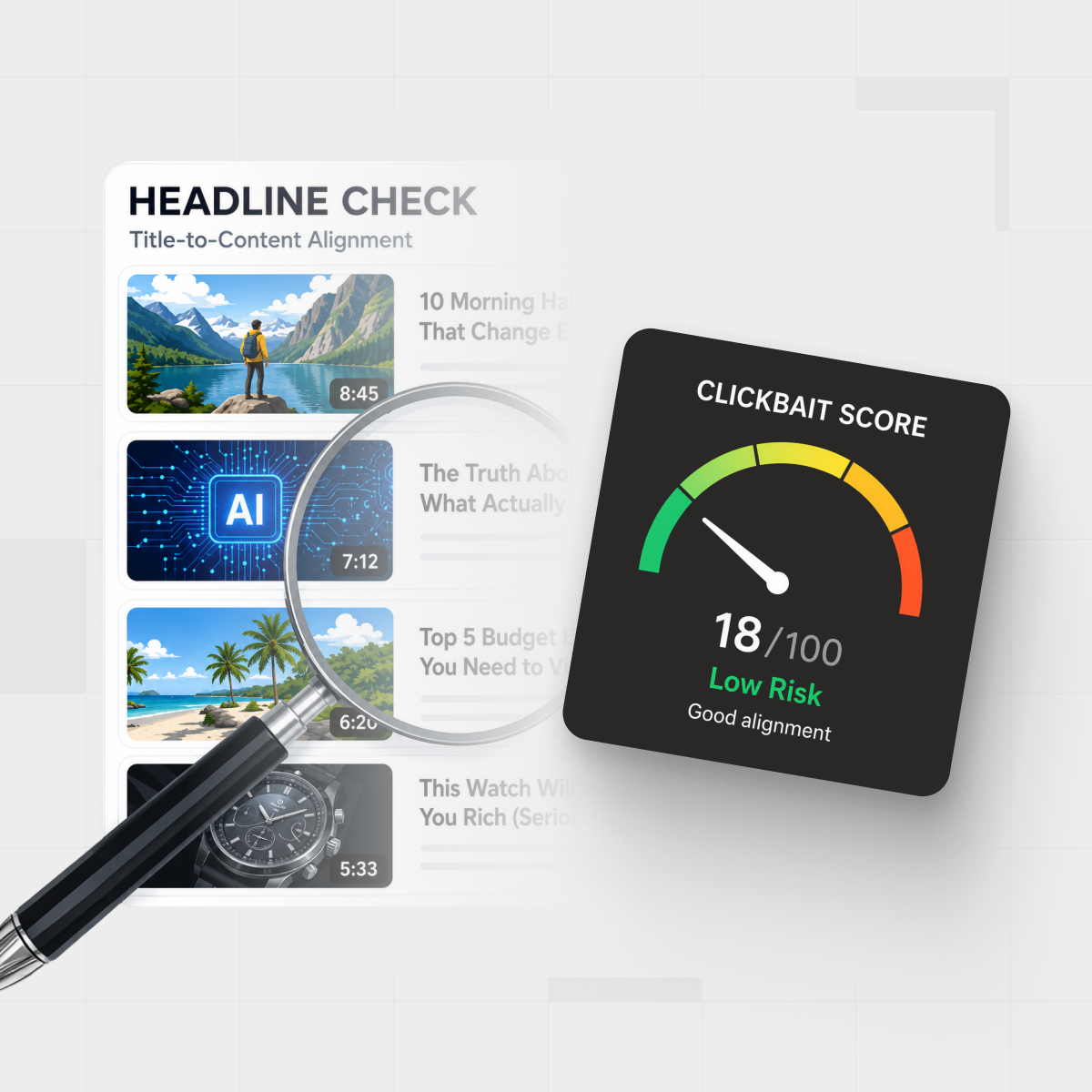
- Pre-screen videos with IsThisClickbait so you can check the transcript, skim an AI-generated summary, and jump straight to the segments that actually teach.
If your students regularly learn from recorded content, see our step-by-step guide to YouTube study routines with playlists.
The Listen–Talk–Write 15-Minute Routine: Make Any Lesson More Auditory-Friendly
Here is a 15-minute pattern we call the Listen–Talk–Write Routine. You can plug it into almost any lesson, from Grade 3 science to high school history, to give auditory learners a predictable structure for hearing, discussing, and then capturing ideas.

The Listen–Talk–Write routine structures lessons so students hear an explanation, talk it through, and then capture their thinking in writing.
- 2 minutes – Story or hook: Share a quick story, scenario, or audio clip that connects to the day’s concept.
- 3 minutes – Mini-explanation: Give a tight, spoken explanation while showing one visual (diagram, problem, image).
- 4 minutes – Turn and talk: Students explain the idea to a partner using a stem such as “In my own words, this means…”
- 4 minutes – Share and clarify: Call on a few pairs, clear up misunderstandings out loud, and model a correct explanation.
- 2 minutes – Verbal to written: Students jot down a sentence or sketch that captures what they just said.
Case example: The Listen–Talk–Write Routine in action
In Ms. Lopez’s 8th-grade science class, the Listen–Talk–Write routine happens right after the warm-up. She tells a quick story about a student forgetting sunscreen on a cloudy day, shows one simple diagram of UV rays hitting Earth, and students turn to a partner to explain why skin can still burn using the stem, “In my own words, this means…”.
Before she adopted the routine, her most talkative, paper-avoidant student would stare at a blank page. Now he usually has a clear sentence starting with “Sunburn happens when…” written within a minute because he has already rehearsed the idea out loud.
Once students know the Listen–Talk–Write routine, you can drop it into new units with almost no explanation. Run it a few times and you will see which auditory learners lock in as soon as they get that “turn and tell” step.
Common Questions About Auditory Learners (FAQ)
How do I know if a student is an auditory learner?
Look for students who perk up during read-alouds, group work, and debates, but seem flat during silent work. They may repeat instructions out loud, talk through problems to themselves, or ask you to re-explain tasks verbally even when they are written on the board.
Is it harmful to label students by learning style?
Rigid labels can box students in. Instead of saying, “You’re an auditory learner, you can only learn by hearing,” try, “You seem to really benefit from hearing and talking through ideas—let’s build that into how you learn.” This mindset keeps doors open to other modes like visuals, movement, and hands-on practice.
What if my classroom is already noisy?
Noise and purposeful sound are different things. Set clear norms for volume, use short listening bursts rather than constant chatter, and lean on cues and routines. If some students need to replay explanations or study from the video at their own pace, our student features page shows how to turn lecture videos into concise study notes they can return to later.
Final Checklist for Planning with Auditory Learners in Mind
As you prep your next lesson, run through this quick checklist:
- Have I planned at least one moment where students talk about the content, not just about logistics?
- Is there a story, scenario, or real-world example students will hear?
- Can I layer in the Listen–Talk–Write 15-Minute Routine or a shorter version of it without overhauling my pacing?
- Did I chunk my explanations into 3–5 minute segments with pauses?
- Do auditory learners have a way to rehearse answers out loud before writing or being graded?
- Have I chosen videos or audio that are clear, concise, and easy to follow?
- Did I think about students who miss class—can they replay directions or watch summarized clips later?
If you are already using YouTube for lectures, flipped lessons, or tutorials, you can save hours each week by letting IsThisClickbait preview videos for you. See what is inside, skip the fluff, and head straight to the parts that will help your auditory learners thrive.